


IPinfo 2025 Year in Review: 1.4 Trillion Requests and What They Revealed About the Internet

Get Unlimited Access to IPinfo Lite
Start using accurate IP data for cybersecurity, compliance, and personalization—no limits, no cost.
Sign up for freeAt IPinfo, we spend a lot of time thinking about what it really means to understand the internet. Not just how big it is, or how fast it’s growing, but how it actually works beneath the surface. Who operates it. How traffic moves. Where assumptions break down. And what happens when decisions are made on data that isn’t quite right.
In 2025, that work took on new urgency. Across a multitude of industries, teams have been seeking genuine IP intelligence, with answers they can trust, explain, and defend. Through 1.4 trillion API requests and data from our global ProbeNet infrastructure spanning 147 countries, IPinfo can tell a remarkable story about this year.
Here's what we saw.
By The Numbers: IPinfo's Record Growth
2025 marked unprecedented expansion across every metric:
API & Dataset Performance
- 1.4 trillion total API requests: 85% year-over-year growth
- +2.55M dataset downloads: 5x year-over-year growth
- 1.24B IPv4s with evidence-backed data: 46% year-over-year growth
Evidence-backed data refers to IPs for which location and network attributes are validated using multiple independent signals, including:
- Active network measurements (RTT latency analysis, traceroute)
- Observed device-level signals
- Operator-published geofeeds
These signals are continuously cross-checked to confirm where an IP is actually located, not just where it is registered.
These aren't just vanity metrics. Each API request represents a decision being made: should we serve this user? Is this traffic legitimate? Where is this request actually coming from? The explosive growth in both API calls and dataset downloads signals that accurate, real-time IP intelligence has become essential infrastructure.
This growth was also shaped by how we broadened access to IPinfo data in 2025. We introduced IPinfo Lite, our free country-level IP dataset, available for both personal and commercial use without request limits, reduced accuracy, or delayed update cycles. Unlike “free” offerings that dilute precision or restrict freshness, Lite reflects the same evidence-based approach used across our paid products.
At the same time, we launched IPinfo Core and IPinfo Plus, making progressively richer IP intelligence, from ASN and privacy detection to deeper network and location attributes, available directly through our API and files. Together, these launches lowered the barrier to entry while enabling teams to scale seamlessly into higher-fidelity IP intelligence as their needs evolved.
ProbeNet: Global IP Intelligence Infrastructure
Our ProbeNet measurement infrastructure reached new scale in 2025:
- 1,309 active Points of Presence (60% YoY growth)
- Geographic coverage:
- 506 autonomous systems (ASNs)
- 146 countries
- 542 cities
- 55% IPv6-enabled
- Performance improvements:
- ASN Median RTT (P50): 1.371 ms
- ASN Median RTT (P75): 5.45 ms
- ASN Median RTT (P90): 12 ms
These improvements translate directly to more accurate geolocation data, which is critical when you're making split-second decisions about network traffic.
Team Growth

The IPinfo team grew more than 50% in 2025. We now have 64 employees in 20 countries around the world, an echo of our ProbeNet coverage. We cover the globe in both infrastructure and employees. I was privileged enough to meet 49 of those colleagues at our annual retreat, this time in Croatia.
The Internet Through IPinfo's Eyes
Processing 1.4 trillion API lookups gave us an unprecedented view into global internet patterns.
What the World Wanted to Know About
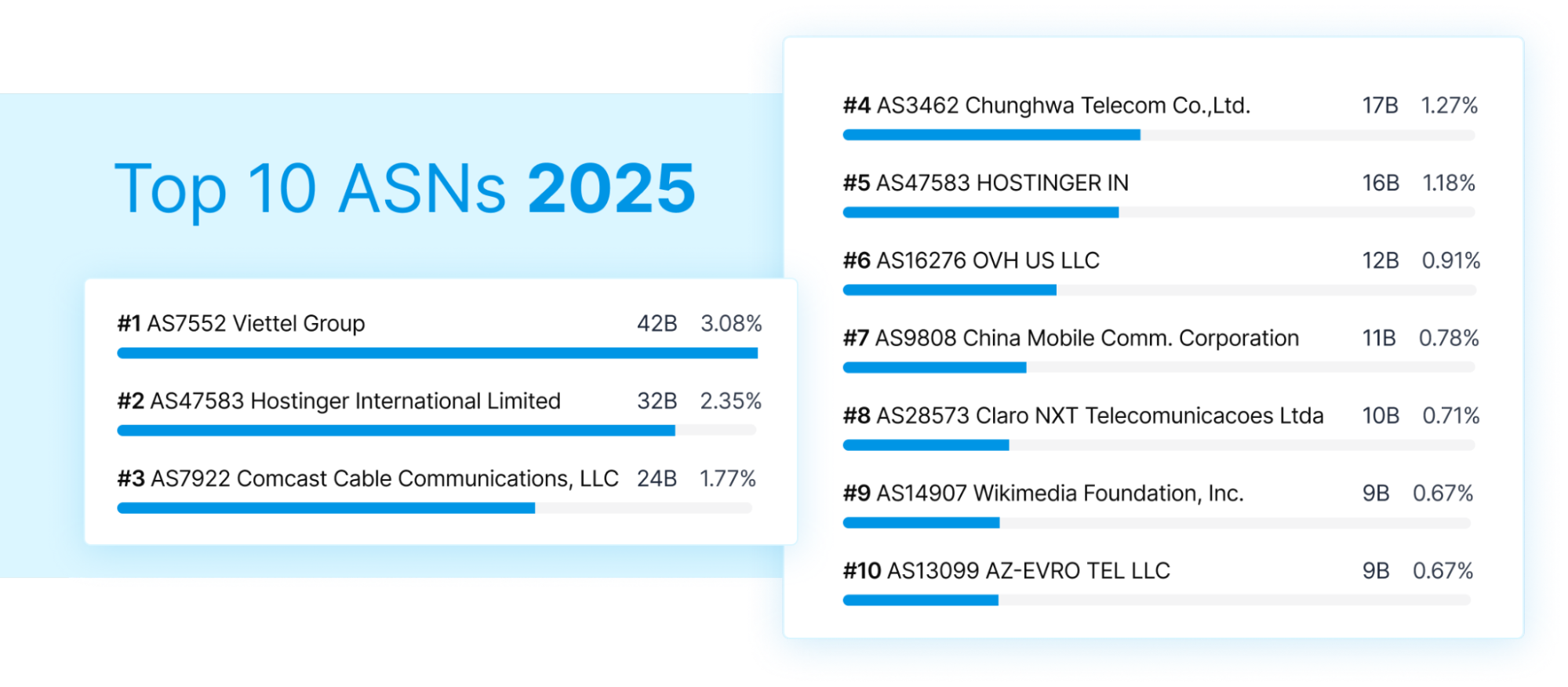
In 2025, the top 10 ASNs accounted for ~13.5% of all IPinfo API requests. Viettel Group (AS7552) led with over 40 billion lookups, reflecting Vietnam's explosive digital growth.
Beyond individual leaders, the Top 10 ASN ranking reveals a clear structural pattern in how IP intelligence is used globally. The list splits almost evenly between large national ISPs (Viettel, Comcast, China Mobile, Claro) and global or regional hosting providers (Hostinger, OVH, AZ-EVRO), highlighting two dominant demand drivers: consumer-scale traffic analysis and infrastructure-level risk assessment.
Notably, no single ASN accounts for more than ~3% of total requests, reinforcing that IP intelligence demand is broadly distributed rather than concentrated in a handful of networks.
Geographic Intelligence Patterns
In 2025, IPinfo API lookups reveal where organizations needed visibility into internet traffic, based on the geographic location of the IPs queried.
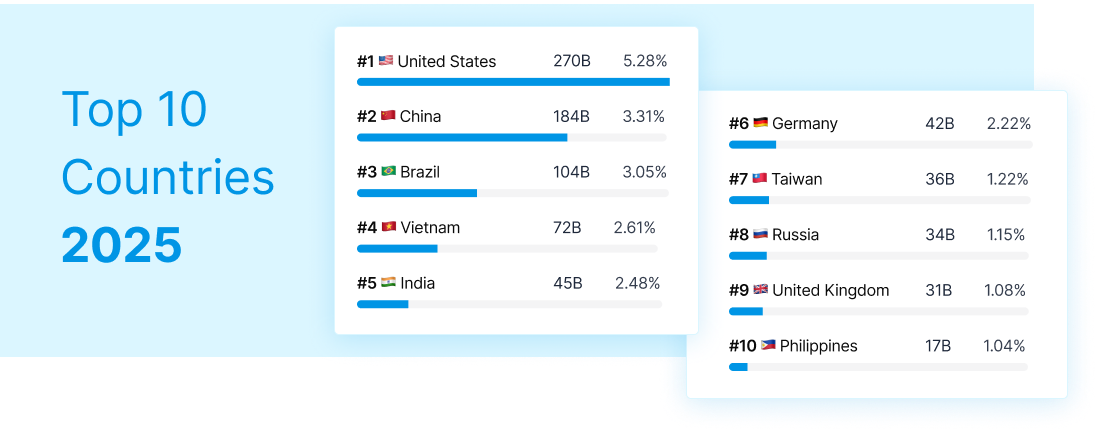
At the country level, IPs located in the United States were queried most frequently, with 270.5B lookups (5.28%), reflecting the country’s central role in global internet infrastructure. China-based IPs followed at 183.8B (3.31%), indicating sustained scrutiny of traffic originating from the region. Brazil (3.05%), Vietnam (2.61%), and India (2.48%) rounded out the top five, highlighting growing digital ecosystems where traffic classification and validation are increasingly important.
No single country dominates IP intelligence demand, even the most queried country accounts for just over 5% of lookups, revealing a highly distributed, global need for traffic visibility.
At the city level, the same pattern holds. Shanghai-based IPs led with 72.4B lookups (5.27%), making it the most frequently queried city globally. Ashburn, Virginia (1.99%), a major data center hub, ranked second, demonstrating that infrastructure locations are analyzed as heavily as population centers. Cities such as Mumbai (1.32%), Frankfurt (0.97%), and Ho Chi Minh City (0.93%) further show that IP intelligence demand spans financial hubs, cloud infrastructure centers, and fast-growing urban regions.
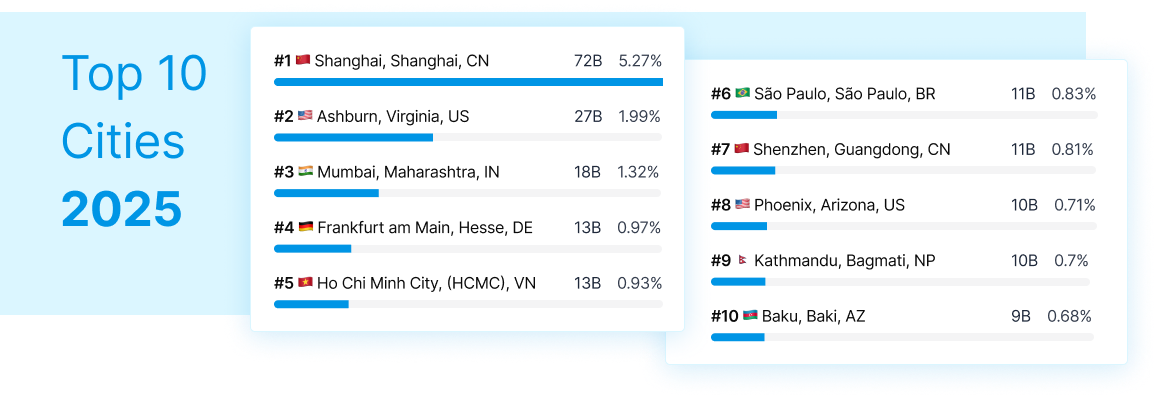
Notably, the distribution is broad: no single country or city accounts for more than 6% of total lookups, and demand quickly tapers into a long tail of regions worldwide..
Browser: The Chrome Monopoly
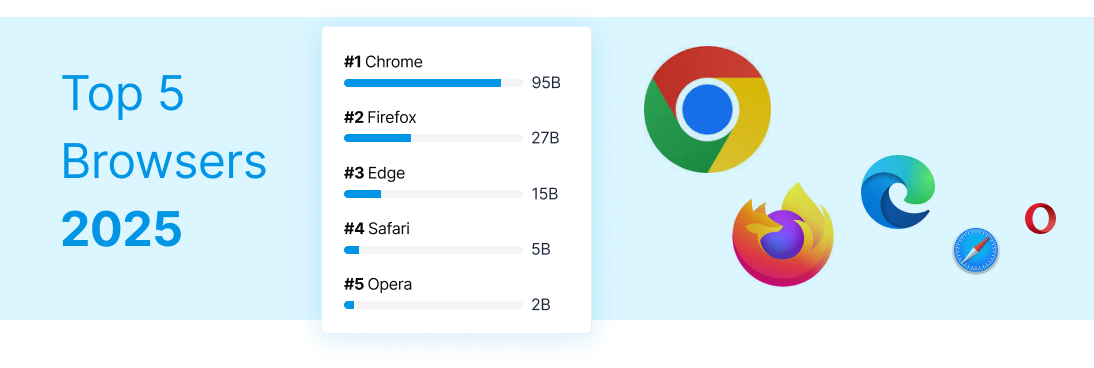
Chrome accounted for almost 100 billion API lookups, vastly outpacing Firefox (27B), Edge (15B), Safari (5B), and Opera (2B) combined.
Our IP Data: Growing and Evolving
2025 wasn't just about more data: it was about better data, more diverse data, and data that reflects how the internet actually works.
Privacy Detection Expansion
Our privacy detection capabilities matured significantly in 2025, with both VPN and residential proxy coverage reaching new levels.
IPinfo now tracks 187 VPN providers globally (up 19% from 157 in June 2024). Our Residential Proxy dataset, launched in January 2025, exploded from 20 million to 148 million unique IP addresses by year’s end: a 7.4× increase in less than 12 months.
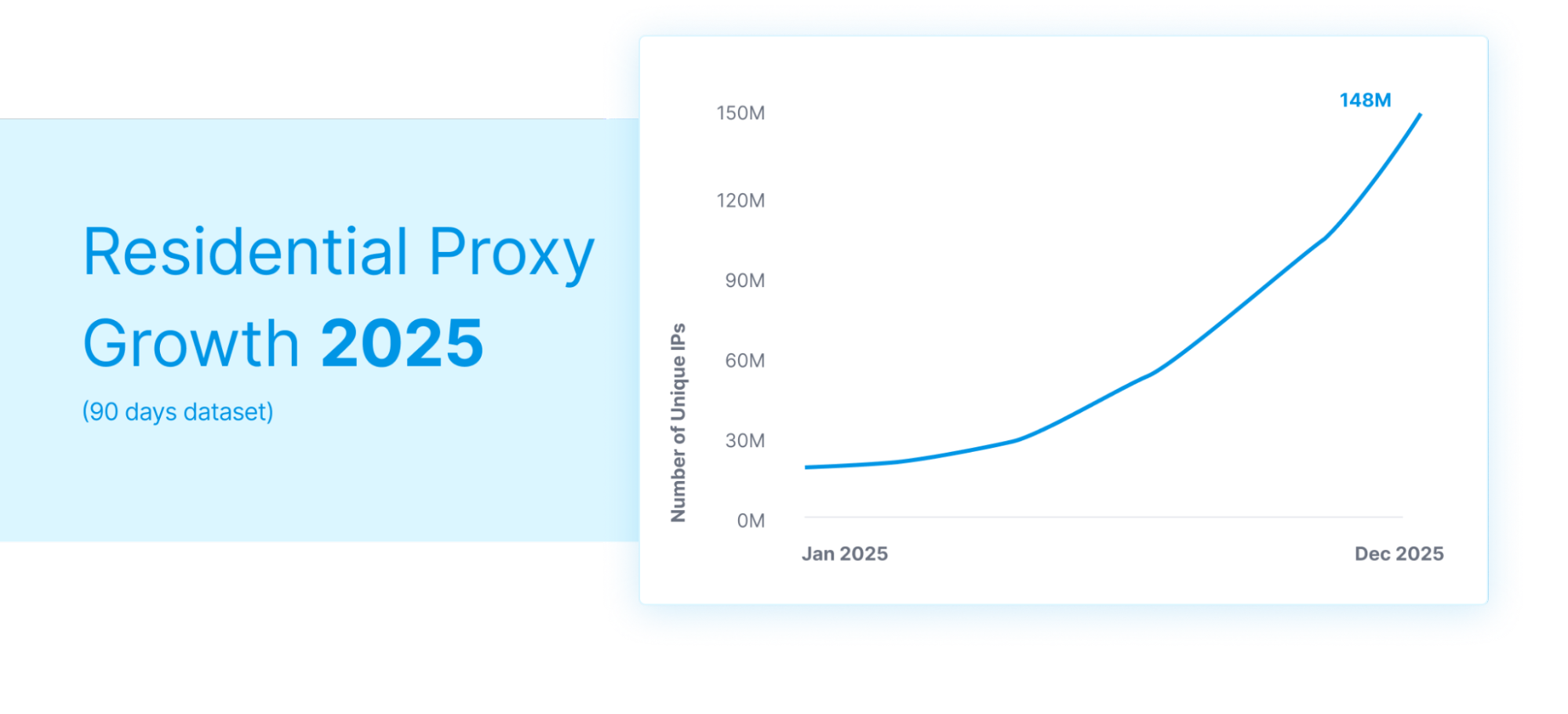
We now offer three time windows (7-day, 30-day, 90-day) with granular metadata including "last day seen" and "percentage days seen" to help organizations distinguish persistent proxy infrastructure from rotating IPs.
We also expanded Residential Proxy to distinguish all three major proxy types through service name suffixes: _mobile, _datacenter, and the base residential classification. This granular classification matters because each proxy type poses different risks and requires different handling:
- Mobile proxies use legitimate cellular carrier IPs, making them the most sophisticated and expensive option. They're significantly harder to detect because they appear as authentic mobile users, and mobile carrier IPs often are already shared by hundreds or thousands of devices due to carrier-grade NAT.
- Datacenter proxies offer speed and stability at lower cost, but are the easiest to detect and block. Most organizations already have policies to handle datacenter traffic, but knowing it's specifically a proxy exit node, not just hosting infrastructure, enables more precise risk decisions.
- Residential proxies sit between the two: harder to detect than datacenter proxies, more cost-effective than mobile. They're the most common proxy type and the reason we launched Residential Proxy in the first place.
Providers like BrightData and Oxylabs among others offer all three types, and our suffix-based classification lets organizations build nuanced detection policies rather than treating all proxy traffic identically.
Our VPN location accuracy research (which gained significant traction on Hacker News with more than 490 points and 300+ comments) validated another critical insight: claimed VPN locations often don't match actual server locations, revealing gaps between provider-advertised geography and measured network reality. These mismatches only become visible through active, global measurement. By leveraging ProbeNet’s distributed infrastructure, IPinfo can validate VPN exit locations based on observed network behavior rather than provider claims or static records: a capability central to our broader data quality and research efforts.
Should You Trust Your VPN Location?
Our VPN analysis explores how VPN providers claim different countries than they actually offer.
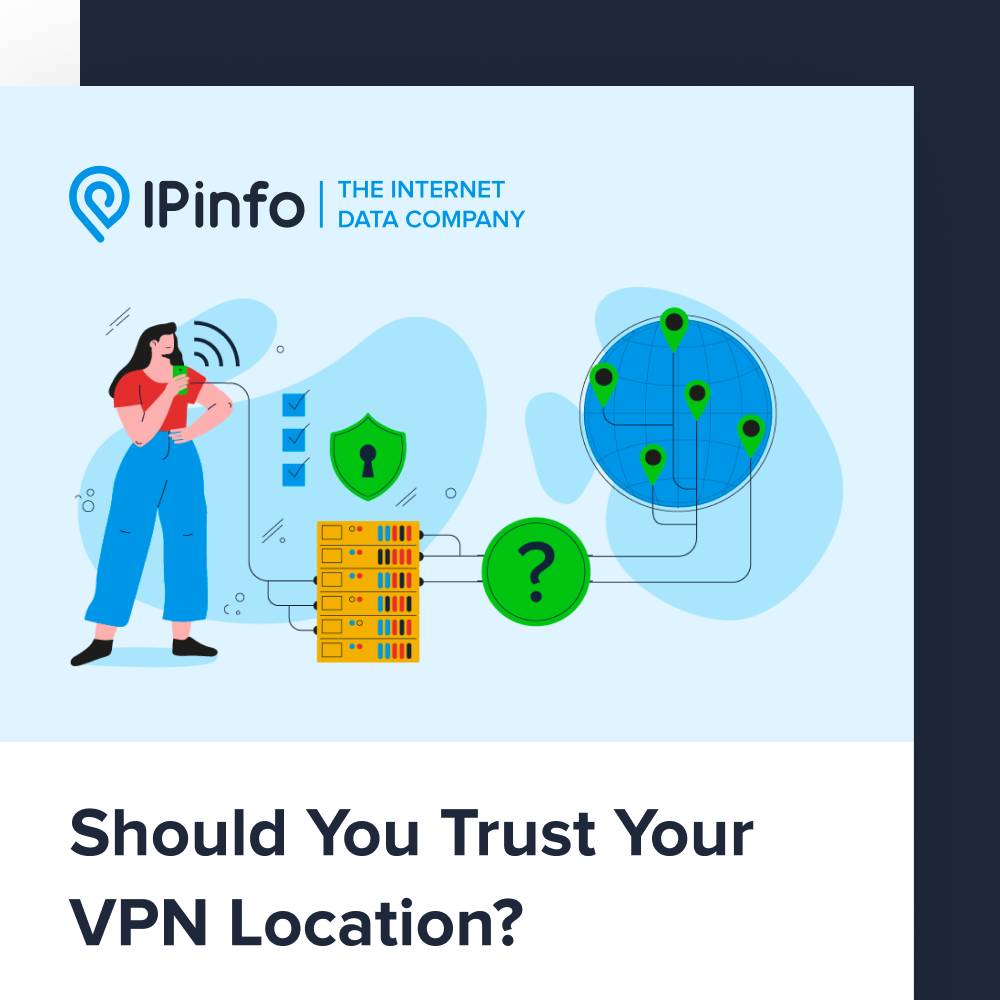
In 2026, we plan to extend this work to provide ongoing, independent visibility into VPN infrastructure, helping customers and the broader ecosystem better understand how VPN location claims compare to observed network reality.
Network Infrastructure in Motion
The way IPs are classified and used continued to evolve:
- Hosting vs residential: The lines blurred further as residential ISPs began offering business-grade services and hosting providers expanded into consumer markets
- Mobile carrier IPs: Growing mobile-first markets drove increased queries about carrier-assigned IPs
- IPv6 adoption signals: Our 55% IPv6-enabled ProbeNet infrastructure both measured and reflected the slow but steady IPv6 adoption curve
Points of Interest: The Physical Internet Revealed
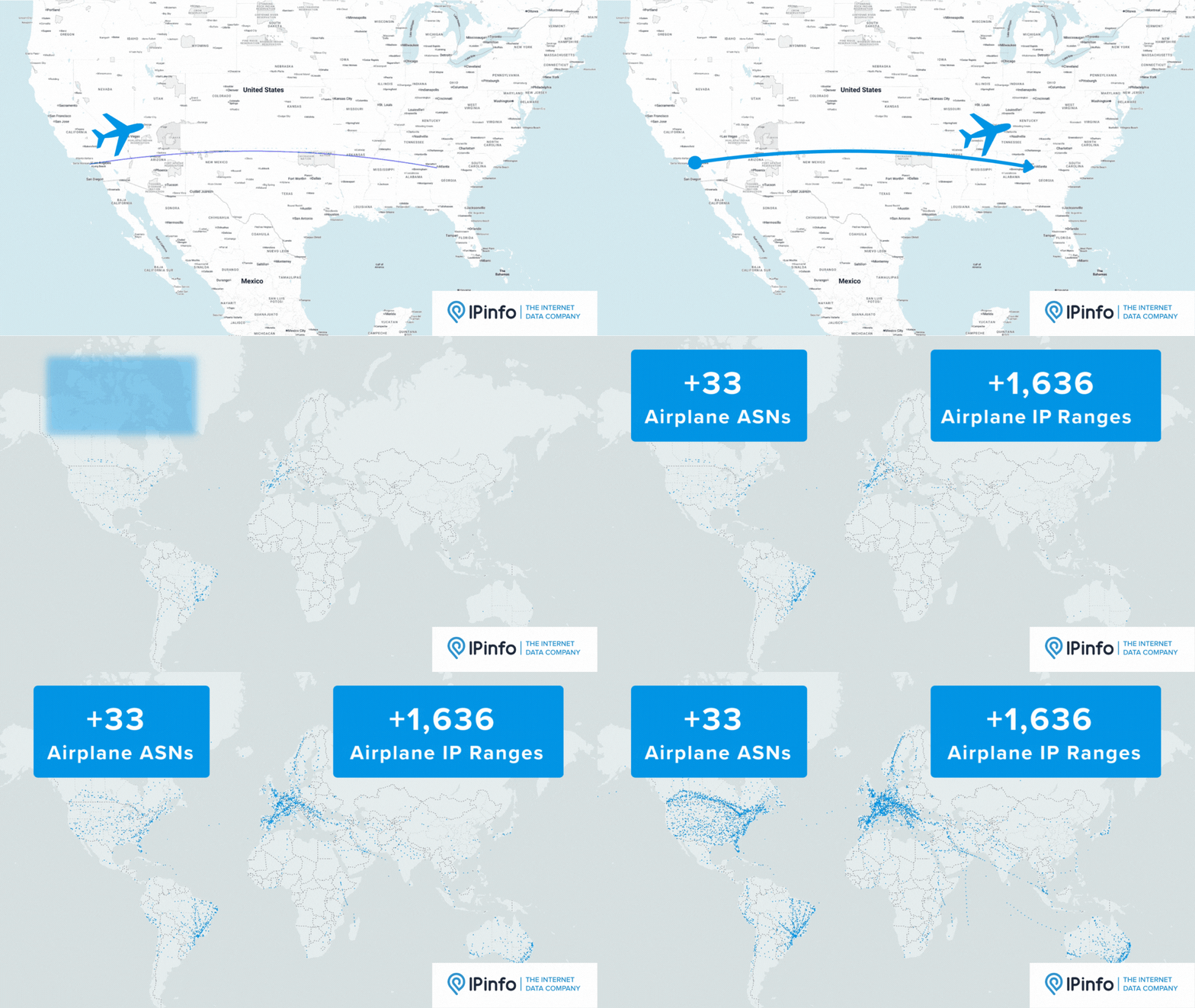
Our POI (Point of Interest) data launches throughout the year: airports, hotels, convention centers, transit hubs revealed something fascinating about the physical infrastructure of the internet. These weren't just new data categories; they showed how internet access is distributed through physical space:
- Airports emerged as major network interchange points
- Hotel networks showed distinct traffic patterns vs residential or business networks
- Convention centers revealed temporary but intense network demand patterns
- Transit networks showed how mobile connectivity meshes with fixed infrastructure
In 2026, we’ll continue expanding our POI coverage with additional location tags, further mapping how internet connectivity manifests across physical spaces and network environments.
Quality & Accuracy: Evidence Over Inference
IPinfo's approach to geolocation represents a fundamental shift from the industry's reliance on legacy self-reported data sources to evidence-backed data.
Evidence-backed IPv4 classifications grew 46% year-over-year to 1.24 billion IPs, but the real story is how we validate them. We build classifications from multiple verified data sources: active network measurements (RTT latency analysis, traceroute), observed device-level signals, and operator-published geofeeds. These signals are cross-checked continuously to confirm where an IP is actually located, not just where it's registered.
The value of this approach was validated at scale when a major global CDN provider serving hundreds of millions of users tested 1 million IPs against their own ground truth dataset built from their global infrastructure and RTT measurements. To ensure fairness, the test excluded all pingable IPs from evaluation, eliminating IPinfo's methodological advantage as the only provider using active RTT measurements.
Even under these constraints, IPinfo achieved 93% accuracy compared to 79% from their existing provider: a 14 percentage point improvement. The results demonstrated that our classification approach outperforms our competitors even when IPinfo's unique measurement capabilities are removed from the equation.
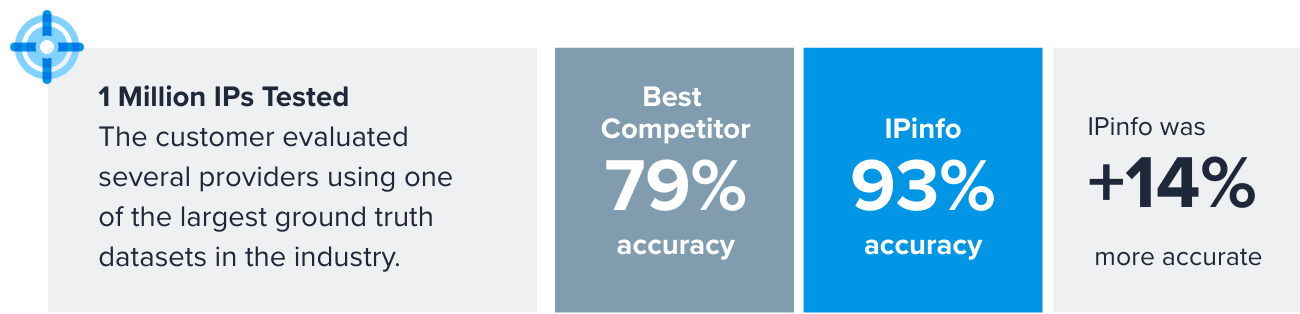
This evidence-based approach gives customers something competitors can't provide: the ability to explain and defend their geolocation decisions when it matters, whether that's in compliance audits, customer disputes, or network optimization planning.
Product Evolution: Bringing Data Where It's Needed
2025 was our most productive year for product development, with strategic releases across four key areas:
Q1: Privacy Detection Foundation. We launched our Residential Proxy Dataset (ResProxy) with Snowflake integration, directly addressing the market's need to distinguish between legitimate residential traffic and proxy networks. Within months, it became one of our fastest-growing products.
Q2: Comprehensive Data Bundles. IPinfo Lite, IPinfo Core, and IPinfo Plus bundles launched with Snowflake packages, addressing a clear market signal: organizations wanted comprehensive IP data packages rather than assembling solutions piecemeal. The growth in dataset downloads and API usage through the year validated this approach.
Q3: Cloud Expansion & Physical Infrastructure. Our Google Cloud Marketplace integration brought IPinfo directly to where customers already work, eliminating new integrations or data pipelines. We also began mapping the physical internet with Airport, Airplane, and Hotel POI categories, revealing how internet access is distributed through physical space.
Q4: Developer Tools & Enhanced Classification. SDK support for all bundle tiers streamlined implementation, while ResProxy's new _datacenter and _mobile suffixes enabled granular proxy type classification. Convention center and transit POI categories completed our physical infrastructure mapping.
Each launch was driven by specific customer needs and real-world use cases, not feature checkbox thinking.
Research Team Expansion

2025 was a breakout year for IPinfo’s research program. Our team grew both in size and recognition, with four papers accepted to top academic conferences: one each at PETS and IMC, and two at CoNEXT. Our data continues to power the global research community, with 14 published papers citing IPinfo datasets, nearly triple the number from last year.
We also launched our first-ever summer research internship. Four interns joined us for an intensive summer, culminating in a retreat in Chicago that brought together mentorship, research, and some Midwestern sunshine.
On the community front, our Academic Research Program saw explosive growth, from 33 researchers last year to 106 by the end of 2025. We were honored to be invited to present at the inaugural IAB IP Geolocation Workshop and to speak at BalticNOG, marking our continued collaboration with the broader network and research ecosystem.
Events and Community

This year, we showed up everywhere. Our research team alone participated in nine major conferences, workshops, and NOG meetings, from IETF and PAM to IMC and PETS. We were proud sponsors at Black Hat USA and Europe, DMEXCO, and multiple research-focused events including TMA and IMC.
Our integration team connected with partners and users at industry gatherings like Snowflake Summit, Google NEXT, and CriblCon. These moments were more than just booths and badges. They were opportunities to deepen relationships and learn from the people building with IPinfo data every day.
Our own IPinfo community keeps showing up, too. This year saw 17 submissions to our Hackathon, with three standout winners who pushed the boundaries of what’s possible with IP data. On Discourse, the community shared over 100 posts, from feature ideas to implementation tips to feedback that helped shape our roadmap.
The IPinfo user base grew with 396,000 new signups in 2025: a 32.5% increase over 2024 and our highest annual user acquisition year on record. This growth reflects the expanding need for accurate IP intelligence across industries, from individual developers to enterprise teams managing infrastructure at scale.
What 2025 Taught Us About 2026
Looking at the year's data reveals several trends that will define 2026:
1. IP Intelligence is Now Critical Infrastructure
Our API requests and dataset downloads growth tell a clear story: organizations can no longer operate without accurate, reliable IP intelligence. This isn't a nice-to-have for security teams: it's foundational infrastructure, like DNS or CDN services.
2. Privacy Detection is Mainstream
The explosive adoption of our Residential Proxy Dataset and the attention our VPN research received signal that privacy detection has moved from specialized security use case to standard practice. Organizations need to understand which traffic comes through privacy services: not to necessarily block it every time, but to handle it appropriately.
3. Evidence-Based Accuracy Wins
The shift toward evidence-backed IP classification isn't just about better data: it's about defensible data. As IP intelligence informs more critical decisions, organizations need data they can explain and defend.
4. Fresh IP Data Requirements Increase
The high daily churn rate in residential proxy networks exemplifies a broader trend: the internet changes too fast for weekly or monthly data updates. Daily updates and continuous monitoring become requirements, not features.
5. Global Infrastructure Becomes More Visible
Our expanded ProbeNet coverage and POI data launches reflect growing demand to understand not just where IPs are located, but what networks they're on, what type of infrastructure they represent, and how they interconnect.
Looking Forward
As we head into 2026, the questions organizations ask about IP addresses are becoming more sophisticated. It's no longer just "where is this IP?" but "where is this IP, what network is it on, has it recently changed classification, is it associated with a privacy service, and what does that combination tell us about the traffic?"
IPinfo's growth in 2025, 1.4 trillion API requests, 286 million evidence-backed IPs, 1,258 ProbeNet locations, positioned us to answer these increasingly complex questions. But more importantly, this data gave us an unparalleled view of how the internet itself is evolving.
2025 further verified our role. We’re here to help organizations see the internet as it actually is, grounded in observation, backed by evidence, and continuously verified as the network evolves. That philosophy shows up everywhere: in how we invest in ProbeNet, in how our research team collaborates, in how we build products based on real-world behavior rather than assumptions, and in how our global team approaches accuracy as a shared responsibility, not a marketing claim.
The internet will keep changing. Our job is to keep measuring it honestly, and to give the people building on top of it data they can rely on when it matters most.
Share this article


About the author

Ben Dowling is Co-CEO and founder of IPinfo. Since founding the company in 2013, he has helped shape the IP intelligence industry by making accurate, verified internet data more accessible to organizations worldwide.