


What We Learned at RSAC 2026 About the Future of IP Intelligence
Get Unlimited Access to IPinfo Lite
Start using accurate IP data for cybersecurity, compliance, and personalization—no limits, no cost.
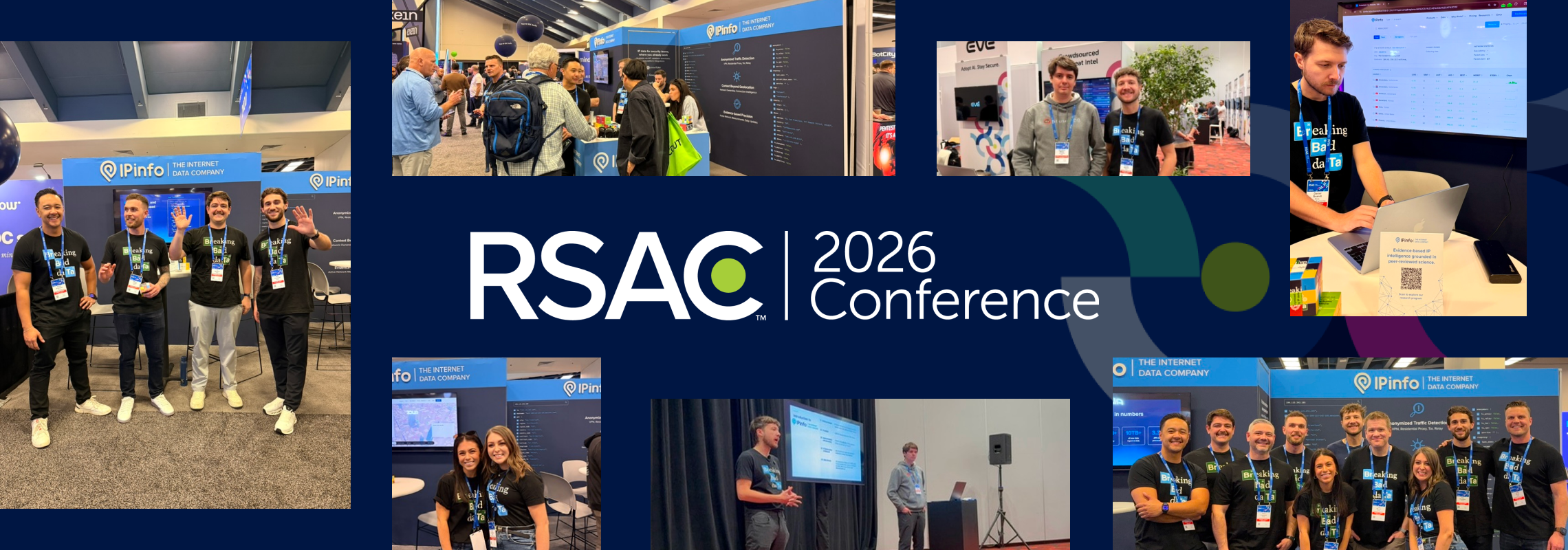
Sign up for freeRSAC 2026’s theme was “The Power of Community,” a recognition that security depends on shared visibility and collaboration. After four days at our booth in San Francisco and hundreds of conversations, that theme felt real, but what stood out most was the level of pressure teams are operating under.
Security, fraud, and infrastructure teams are moving faster, making higher-stakes decisions, and tying those decisions directly to business impact.
The conversations at our booth reflected that shift clearly, and they pointed to where IP intelligence is heading.
The SOC Is Getting Smarter, and Hungrier for Context
This year’s conference centered on the “Agentic SOC,” where security operations move toward AI-assisted investigation and response.
At our booth, that trend showed up in practical ways. Teams focused on how to bring more context into their pipelines, faster, and make it usable inside automated workflows.
They asked for:
- More accurate geolocation
- Stronger signals for VPNs, proxies, and hosting infrastructure
- Clear ways to distinguish legitimate users from suspicious traffic
- Data they can trust inside automated systems
The role of IP data is expanding, supporting real-time decisions inside systems that act on their own. The audience reflected this shift as well. Conversations leaned toward executives and decision-makers, with a focus on business impact and ROI, how to extend value across existing systems, and where better data changes outcomes.
The quality of these conversations stood out: Teams focused on outcomes and impact.
Geolocation Accuracy Has Become a Trust Issue
Geolocation accuracy came up in nearly every conversation.
Teams described the impact of inaccurate data:
- False positives in fraud detection
- Misattributed alerts in SIEM pipelines
- Compliance risks tied to incorrect country resolution
- Reduced confidence in internal systems
The turning point in these conversations came from explaining how the data is built.
Once we walked through our measurement-based approach, and how ProbeNet, IPinfo’s internet measurement platform, verifies location through active observation, people connected the dots quickly. Measured data behaves differently than inferred data, and that distinction resonated immediately.
ProbeNet gave people a concrete way to understand why accuracy holds up in real-world systems.
We also heard strong feedback from existing users, especially around the simplicity and clarity of the product experience.
Residential Proxies: The Blind Spot Everyone Is Waking Up To
Residential proxies surfaced as a key challenge across conversations.
Teams described:
- Traffic that appears residential but behaves inconsistently
- Accounts shifting across regions in short timeframes
- Infrastructure blending into normal user activity
Detection approaches are evolving alongside these patterns. Awareness is increasing, and teams are actively looking for signals that reflect how this infrastructure behaves today.
The Data Accuracy Arms Race Is Accelerating
RSAC 2026 highlighted rapid progress in AI-driven security analytics and automated workflows. These systems depend on the quality of the data they ingest.
That relationship came up repeatedly:
- Higher automation increases reliance on input data
- Stronger models amplify both good and bad signals
- Better inputs lead to better decisions
At the same time, the environment continues to evolve quickly. Teams described the broader challenge:
- AI increasing the scale and speed of activity
- Residential proxies and anonymization infrastructure evolving rapidly
- New data sources appearing constantly
This environment raises expectations. Teams want data that reflects current conditions and supports decisions that drive measurable outcomes.
ROI came up consistently in that context. The focus stayed on impact, and how better, more comprehensive data improves accuracy, reduces noise, and strengthens decisions.
Identity Goes Beyond the User
The growth of non-human identities was another major theme. Bots, services, APIs, and AI agents now make up a large share of activity across systems.
That shift expands how teams think about identity and context. At the booth, conversations focused on understanding the entity and context behind traffic:
- Network type (residential, hosting, mobile)
- Stability and behavior over time
- Alignment between observed activity and expected patterns
Latin America Is a Rising Force in Cybersecurity
The international presence at RSAC stood out this year.
We spoke with teams from across Latin America, including Brazil, Argentina, Mexico, Peru, and Chile, alongside a broader mix of global attendees.
The conversations reflected growing maturity in security operations and a strong interest in accurate, globally consistent IP data.
The mix of attendees felt more diverse than in previous years, both in geography and in use cases.
A Sneak Peek at What’s Next: Places and ProbeNet Live
Two areas generated strong engagement at the booth.
IPinfo Places introduced a new layer of context by mapping IPs to the types of venues where they are used. This adds meaningful detail to investigations and policy decisions by connecting network activity to physical environments.
ProbeNet Live drew interest from technical audiences looking for direct access to measurement data. It provides visibility into network behavior from a globally distributed set of points of presence.
These conversations reinforced a clear theme: teams value transparency into how data is generated, not just the output itself.
What We’re Taking Home
The combination of our multiple datasets working together supports real workflows where multiple signals come together to inform decisions.
One moment captured this clearly, when someone stopped by our booth to say, “A bunch of my analysts use you guys and they love you, so I wanted to stop by and see what it’s all about and see what we can put together.”
That kind of bottom-up adoption reflects trust and real usage inside teams.
RSAC 2026 reinforced a broader shift: IP intelligence is becoming a foundational part of modern infrastructure.
Systems are more automated. Decisions move faster. The impact of accuracy continues to grow.
Teams are building on data they can verify, trust, and integrate into their workflows. We’re grateful to everyone who stopped by, shared their perspective, and pushed these conversations forward.
See you at RSAC 2027.
Share this article


About the author

Alexa leads digital demand at IPinfo, helping technical teams and security leaders alike discover how IP intelligence can power their products and workflows.