


Get Unlimited Access to IPinfo Lite
Start using accurate IP data for cybersecurity, compliance, and personalization—no limits, no cost.
Sign up for freeEvery week, IPinfo actively measures the entire routable internet. Not a sample. Not a subset. The full address space.
This information is the foundation of everything we do. While most IP intelligence providers rely on self-reported registry data from WHOIS and geofeeds, we built something different: ProbeNet, a self-owned and operated internet measurement platform that generates the ground truth behind our geolocation, network, and privacy intelligence data.
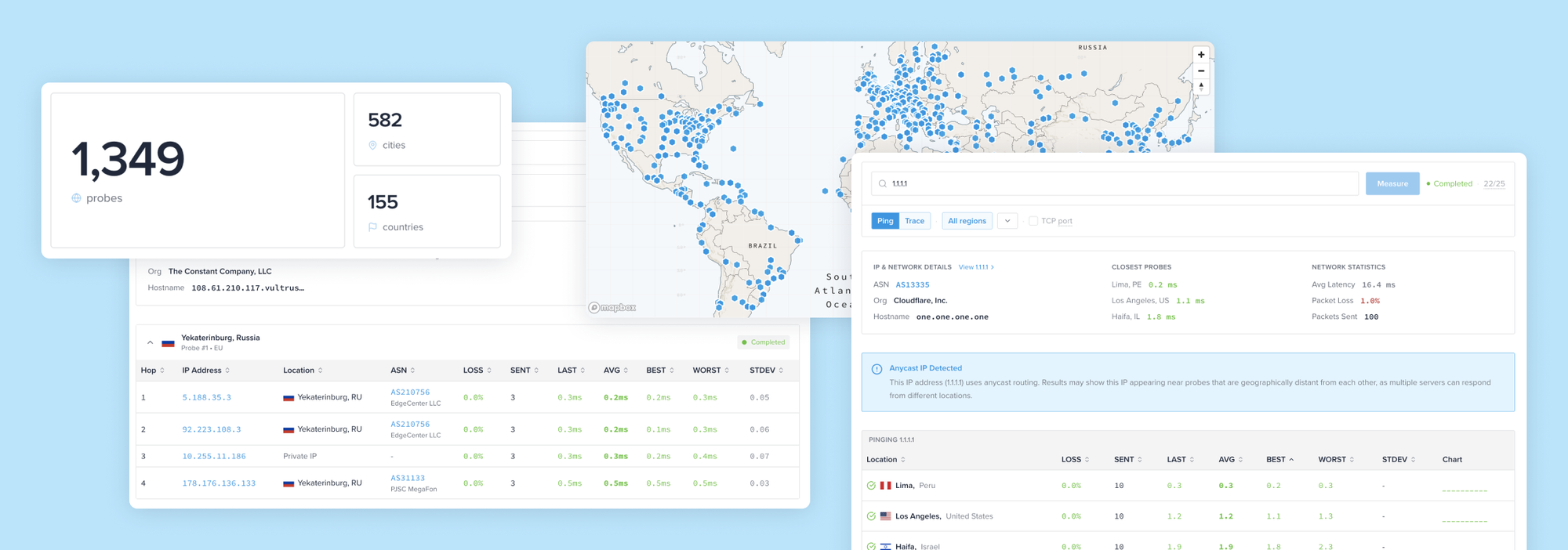
Today, we're making that infrastructure directly accessible. With the launch of ProbeNet Live, we're opening a window into the same measurement capabilities that power our data accuracy, so you can run real-time network diagnostics from 150+ countries, troubleshoot connectivity issues, and see how the internet actually behaves from points of presence (PoPs) around the world.
It's a step toward democratizing access to one of the most important data sources in IP intelligence, and it reflects our belief that data claims should be verifiable, not taken on faith.
The Infrastructure Behind the Data
ProbeNet is a distributed fleet of over 1,300 active points of presence spanning 158 countries and 573 cities. It runs over 5.2 billion active measurements monthly, reaching half the internet in under 1.5 milliseconds.
This scale provides superior quality signals we can extract. Our system:
- Triangulates IP locations through layered network attributes and geometrical calculations based on RTT (Round Trip Time), rather than trusting a registry entry at face value.
- Identifies high-latency and data-sparse regions like North Africa or the Pacific Islands and strategically places servers where other providers have blind spots.
- Tracks IP stability to detect reassignment and geo-drift in real time, catching changes that static databases miss entirely.
- Conducts live privacy detection by analyzing handshake behaviors and port scans to flag VPNs.
Currently, 60% of our points of presence are IPv6-enabled, reflecting our commitment to the evolving internet.
We’re striving for something beyond accuracy, providing a fundamentally different approach to solving IP data problems. We generate our own independent, measurement-backed evidence at global scale, so we don't inherit the limitations of someone else's data. We measure the internet directly, and that gives us visibility that third-party-dependent providers simply can't match.
Why We Built ProbeNet Live
As ProbeNet matured, our users started asking a natural question: can we use it directly?
They wanted to run network diagnostics, identify routing and peering issues, test connectivity, and benchmark latency from real-world locations without having to build or maintain their own infrastructure.
ProbeNet Live answers that question. It's a platform that opens direct access to our probe network so you can run real-time measurements from anywhere in the world.
The tool fills a gap that existing solutions don't cover: standard geolocation tools are lookup-only, showing you a database entry with no way to verify it. Ping tools offer raw measurements but no IP intelligence context. ProbeNet Live provides both: measurement and context in one place. Alongside the latency data, you see everything IPinfo knows about that IP: ASN, organization, hostname, and more.
Ping Measurement
ProbeNet Live's ICMP and TCP ping tests let you measure the round-trip time to your service from points of presence distributed across multiple continents. By testing from different PoPs, you can see how network latency varies globally and quickly identify regions experiencing slow connections or packet loss.
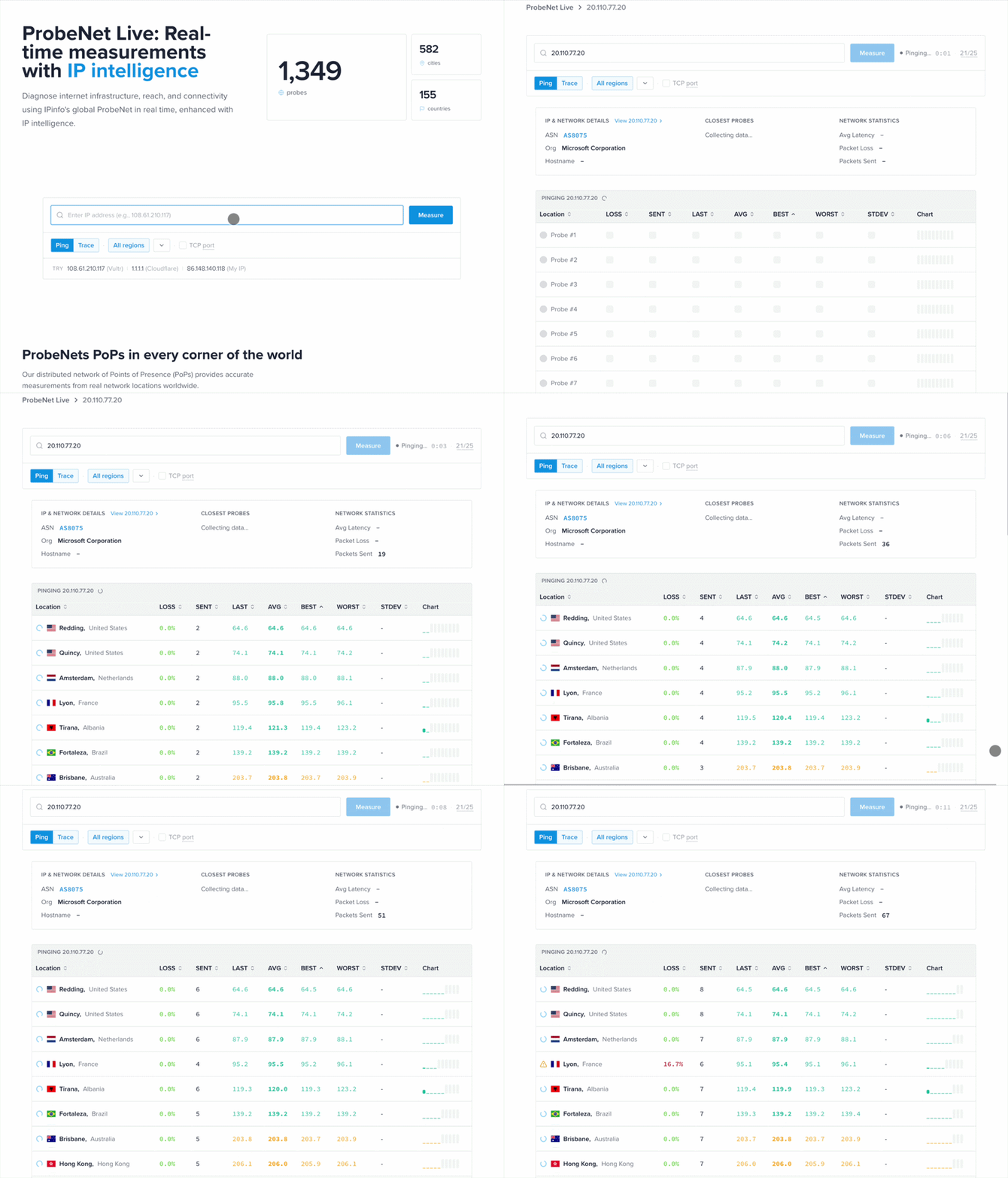
For example, pings from Europe might return 20–30 ms, while Asia shows 250 ms, revealing potential transit issues or routing inefficiencies. This global perspective helps teams validate performance, monitor service reachability, and troubleshoot regional network problems that would be invisible from a single monitoring location.
The ping mechanism supports both ICMP and TCP pings, each with distinct strengths:
In practice, ICMP is your first quick check, and TCP is the follow-up when you need to confirm a specific service is reachable or when ICMP gives no response. They complement each other rather than compete.
Trace Measurement
ProbeNet Live's traceroute feature maps the path packets take from points of presence across multiple continents to your service. By measuring from different PoPs, you can identify where latency spikes, packet loss, or routing anomalies occur, even if your servers appear healthy.
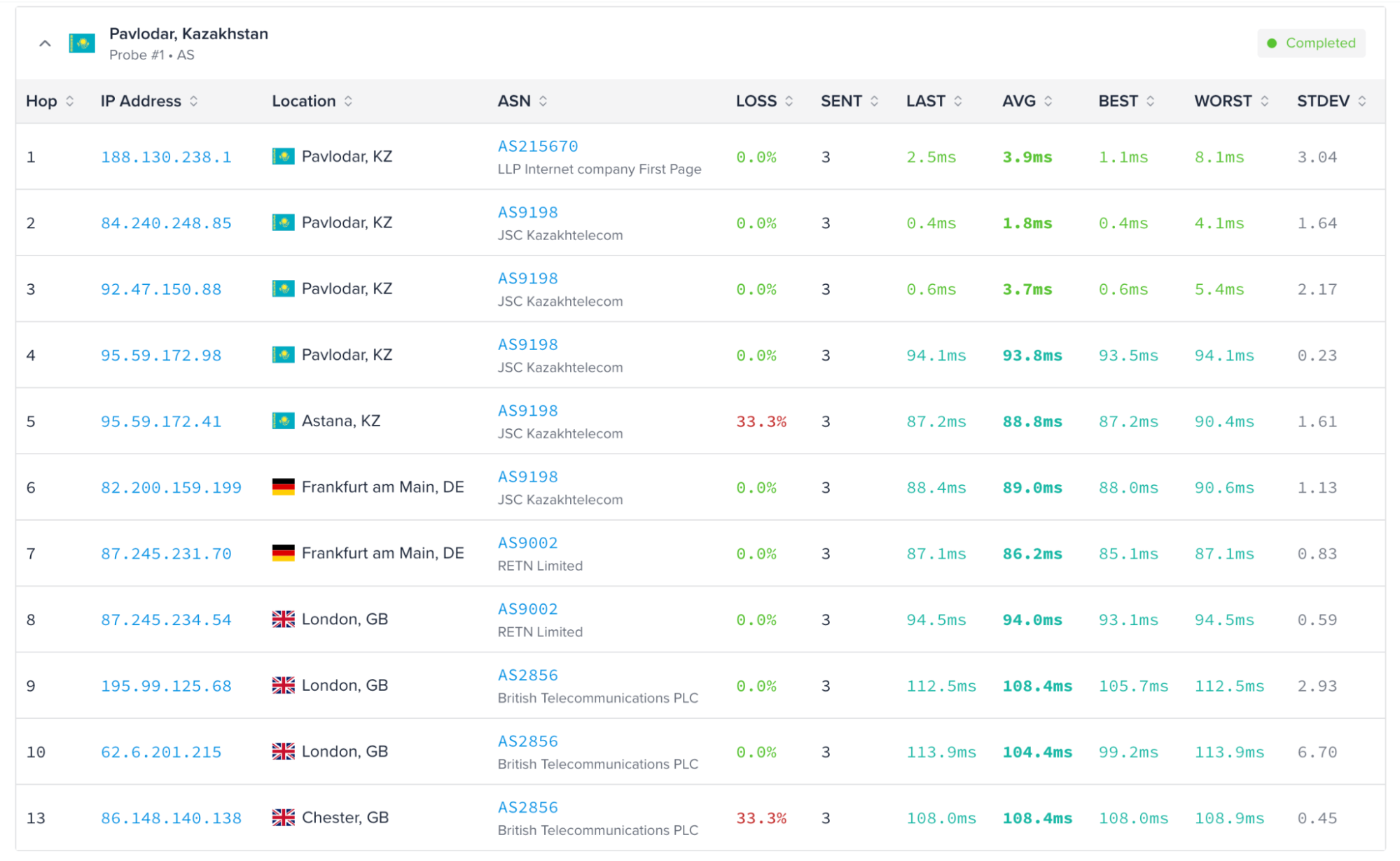
A traceroute from Asia might reveal that traffic passes through a congested transit network causing high latency, while Europe shows a smooth path with minimal delay. This multi-continent perspective helps teams pinpoint regional network issues, optimize routing, and troubleshoot connectivity problems that would be invisible from a single location.
Features
Insights at a Glance
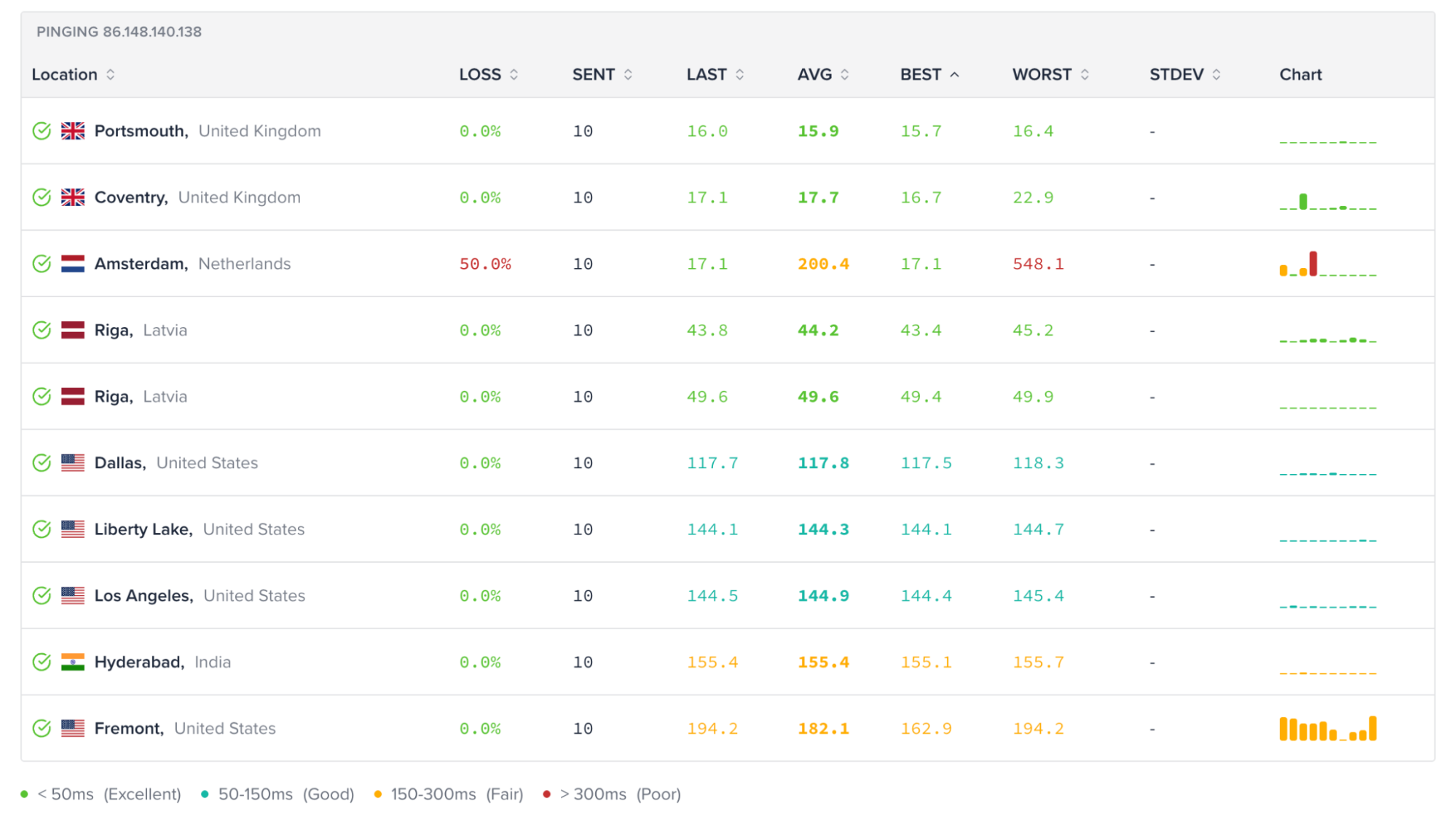
The UX is designed to surface results instantly. Metrics are color-coded by performance tier (< 50 ms Excellent, 50–150 ms Good, 150–300 ms Fair, > 300 ms Poor), and each point of presence includes a real-time sparkline chart so you can spot patterns without digging into the numbers.
Pingable IP Suggestions
If an IP address isn't pingable, ProbeNet Live highlights this and shares nearby pingable IP addresses within the same network neighborhood so you can run measurements against them instead.

Anycast IP Detection
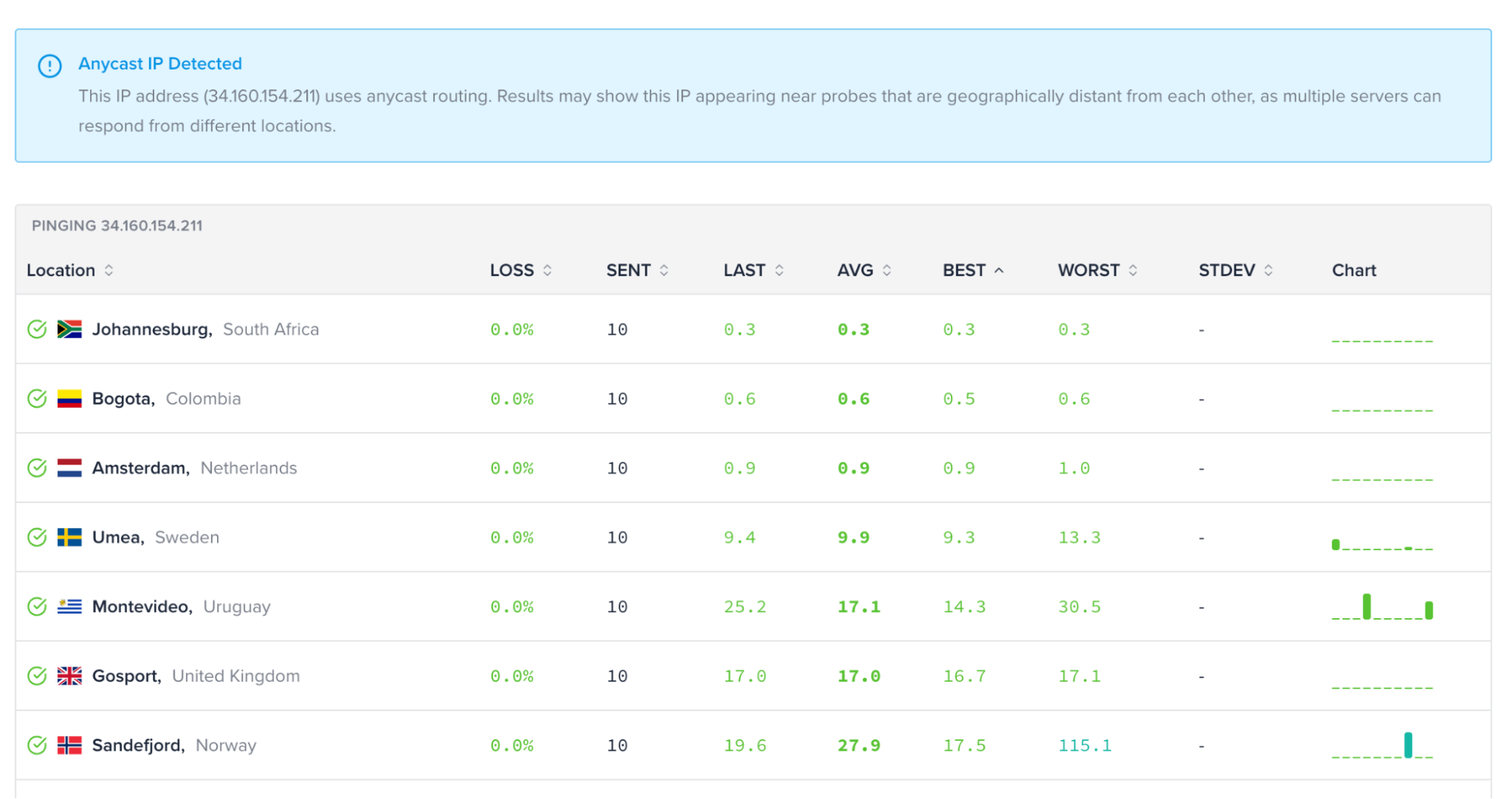
If an IP address uses anycast routing, ProbeNet Live flags it during the measurement. This helps you understand why latency may appear low from many geographically distant points of presence — multiple servers are responding from different locations.
IP Geolocation Validation With ProbeNet Live
ProbeNet Live's daily measurement allowance isn't designed to geolocate an IP address from scratch, but it's a powerful tool for validating geolocation claims.
Here's a real example. The IP address 80.76.52.43 has a geofeed entry claiming it's located in Jakarta, Indonesia:
IPinfo geolocates this IP to the United States. After running a ping measurement, ProbeNet Live shows that we have a point of presence in the exact data center of the target IP, located in Los Angeles, with latency of just 0.5 ms. The closest PoPs are all in the western US (Los Angeles, Fremont, Seattle), and the trace measurement confirms that traffic stays entirely within the US, routing toward Los Angeles.
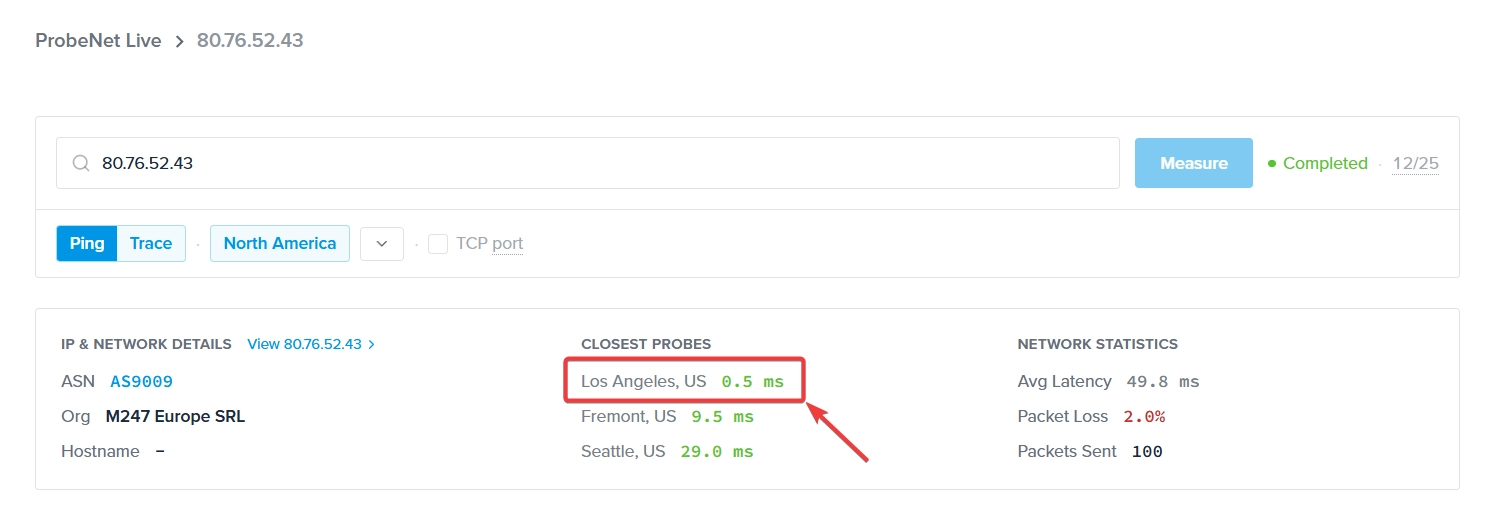
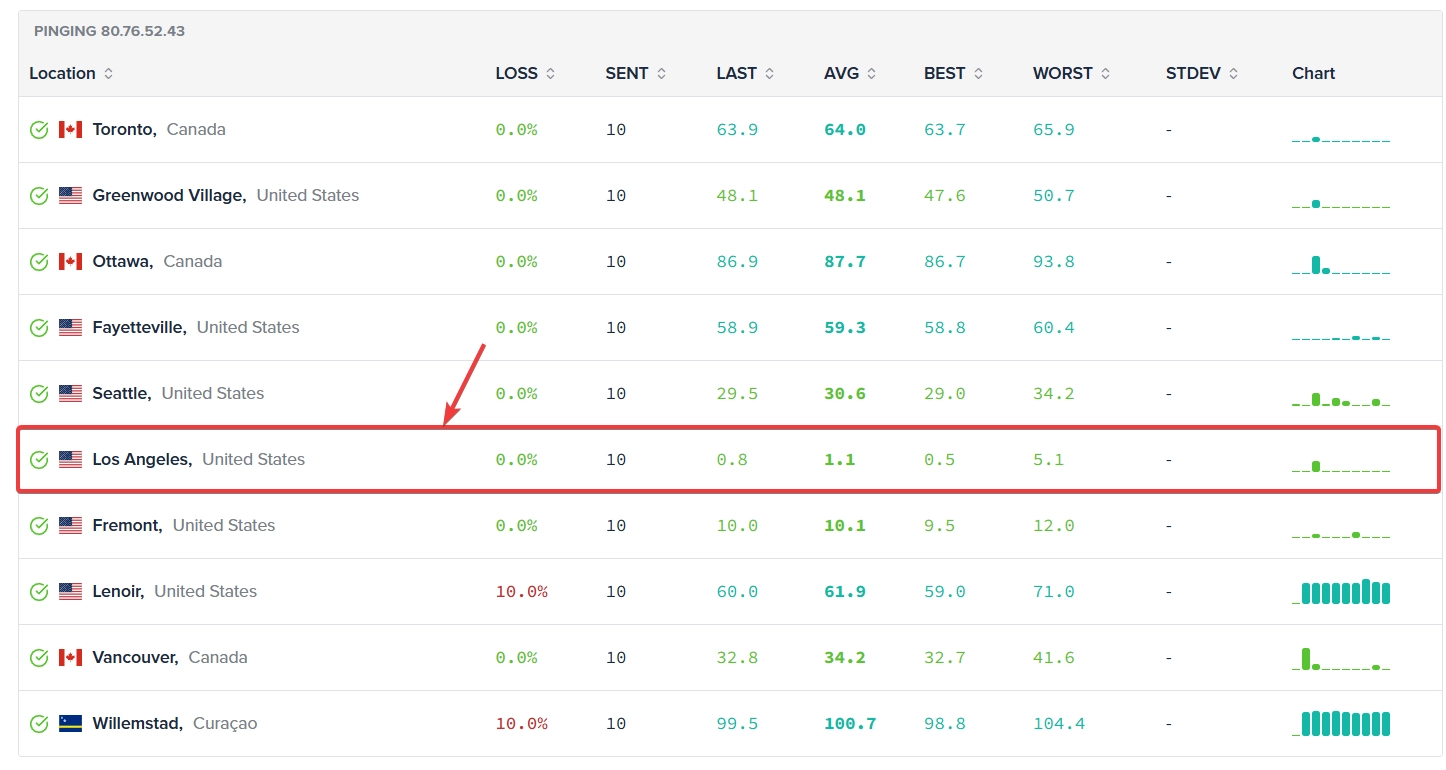
This is evidence over assumption in action. The geofeed says Jakarta. The physics of the network say Los Angeles. ProbeNet Live lets you see that evidence for yourself.
For developers, security teams, and network admins, this workflow is straightforward:
- Verify geolocation accuracy. Run measurements from probes across multiple continents. By observing RTTs from different points of presence, you can verify where an IP is actually routing versus where a registry claims it's located.
- Detect routing anomalies. Run traceroutes from multiple global PoPs to troubleshoot path anomalies and verify anycast configurations.
- Let the physics speak. If an IP shows extremely low latency to a point of presence in a specific city, that's empirical evidence of physical proximity.
Get Started, No Credit Card Required
ProbeNet Live is free to use. Each ping run across 10 point of presence locations counts as a single measurement, and each traceroute run per PoP counts as one measurement. You get 25 measurements per day, refreshed daily, more than enough to diagnose most issues, investigate a routing anomaly, or validate performance across regions.
The PoP selection mechanism is currently randomized. Internally, we run these measurements continuously to generate reliable IP data. Future improvements may include targeted PoP selection, API access, and additional filtering options.
Try ProbeNet Live Now
ProbeNet Live is available now to all IPinfo users. No setup required.
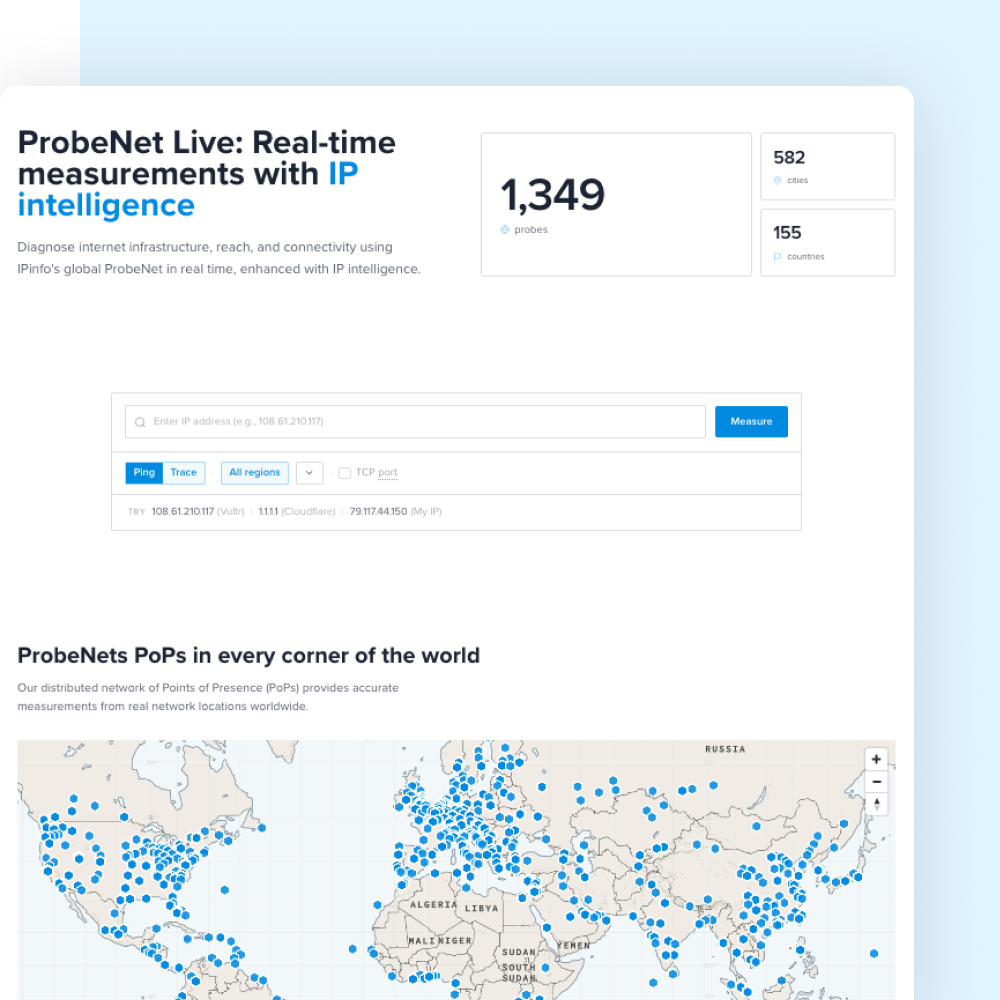
Whether you're diagnosing a regional outage, validating routing paths, or simply curious how the world sees your infrastructure, ProbeNet Live gives you the vantage point to find out.
Have feedback or a use case you'd like to see supported? Reach out via our community forum or drop us a note at support@ipinfo.io.
Share this article


About the author

Abdullah leads the IPinfo internet data community and he also works on expanding IPinfo’s probe network of servers across the globe.